Comparing panel retention among Ukrainian and other refugees in a German probability-based panel: Evidence from a decomposition analysis

Schütt, J. & Sommer, E. (2026). Comparing panel retention among Ukrainian and other refugees in a German probability-based panel: Evidence from a decomposition analysis. Survey Methods: Insights from the Field. Retrieved from https://surveyinsights.org/?p=22000
© the authors 2026. This work is licensed under a Creative Commons Attribution 4.0 International License (CC BY 4.0) 
Abstract
Despite the rise in global refugee migration, probability panels surveying refugees remain rare. The German IAB-BAMF-SOEP Survey of Refugees, conducted annually since 2016, provides valuable panel data for research. In 2023, following Russia’s invasion of Ukraine, a sample of Ukrainian refugees was added, along with a refreshment sample of refugees from other countries. This paper examines household-, individual-, and interview-related determinants of panel retention across these two groups of refugees. As a proof of concept, we apply the Kitagawa-Blinder-Oaxaca decomposition to assess whether it offers analytical insight for comparative panel retention analysis beyond standard group-indicator regression by separating compositional from non-compositional sources of retention differences. Although initial participation was similar, Ukrainian refugees demonstrated significantly higher panel retention in the second wave. To assess the source of this retention gap, we first analyse the determinants of panel retention between the first and the second survey wave and then decompose the retention difference to quantify how much of it stemmed from sample composition. Our findings indicate that the disparities in panel retention between the two groups are almost entirely attributable to differences in sample composition rather than to other factors, as confirmed by the decomposition analysis. Beyond providing insights into panel retention determinants and the sources of retention gaps, the paper discusses the additional value and challenges of applying the Kitagawa-Blinder-Oaxaca decomposition in comparative panel retention analysis.
Keywords
decomposition, hard to reach populations, panel retention, probability-based household panel, surveying refugee population
Acknowledgement
This research was supported by the research grant SUARE: 518967487 of the German Research Foundation (DFG). We thank the anonymous reviewers for their constructive feedback and insightful suggestions, which have contributed to improving the quality and clarity of this paper.
Copyright
© the authors 2026. This work is licensed under a Creative Commons Attribution 4.0 International License (CC BY 4.0)
Introduction
Due to the increasing global refugee population, longitudinal studies of refugees are essential for receiving societies to monitor integration processes and assess the needs of this vulnerable group. However, surveying migrants, particularly refugees, presents various challenges (Méndez & Font, 2013; Wenzel et al., 2022). Research indicates lower survey participation rates among migrants and ethnic minorities, especially hard-to-reach populations like refugees and those with unprotected legal status (Feskens et al., 2007; Lipps et al., 2013; Duvoisin et al., 2024). Probability-based panels of migrant populations often experience lower retention rates compared to general population panels, with variations among different migrant or ethnic groups (Cabrera-Álvarez et al., 2023; Jacobsen & Kühne, 2021; Siegers et al., 2022). This is partly due to socio-demographic differences, as certain characteristics correlate with higher non-response rates (Jacobsen & Siegert, 2023).
Attrition in a probability panel threatens data quality. Non-random attrition can introduce bias in survey estimates and limit subgroup analysis (Feskens et al., 2007; Lipps et al., 2013; Lynn & Borkowska, 2018). Representativeness depends on both the sampling process and the selectivity of non-response; while probability sampling aims to ensure initial representativeness, selective non-response can erode it over time (Groves et al., 2009; Massey & Tourangeau, 2012). While survey weights are used to address panel attrition in general population surveys, the under-representation of subgroups is more pronounced in surveys of migrants and refugees, necessitating adjustments to fieldwork procedures (Duvoisin et al., 2024). In panels with hard-to-reach populations, weighting adjustments are limited when retention is particularly low for certain subgroups: the few remaining cases receive very large weights, resulting in unstable estimates. Moreover, if these remaining cases are themselves systematically different from those who dropped out, weighting cannot correct for the residual bias (Vandecasteele & Debels, 2007). Therefore, insights from analysing factors affecting panel retention are crucial for developing strategies to maximise retention in specific groups, especially in the early waves of a panel, where retention is typically lowest (Cabrera-Álvarez et al., 2023; Jacobsen & Siegert, 2023; Brücker et al., 2025). This paper focuses on identifying the determinants of panel retention in a refugee panel study in order to inform potential strategies that prevent panel drop-out, rather than to inform post-hoc weighting adjustments.
Studies examining panel retention of refugee populations are generally rare, particularly from a comparative perspective. To date, we have only identified one study that compares panel retention among a refugee sample, a sample of non-refugee migrants, and a general population sample in a probability-based panel (Jacobsen & Siegert, 2023). However, no studies analyse panel retention differences among refugee groups from different origins. This paper aims to address this research gap. The starting point for this paper was the observation of varying participation rates between two groups of refugees in the German IAB-BAMF-SOEP Survey of Refugees. In 2023, a new sample of Ukrainian refugees and a refreshment sample of refugees from other countries were added to the existing panel. Initial participation was somewhat higher among Ukrainian refugees, but retention in the second wave was significantly higher in the Ukrainian sample compared to refugees from other countries. We distinguish between Ukrainian refugees and refugees from other countries because these groups differ in several structurally relevant aspects within the German context. Most importantly, they are subject to different legal frameworks. While refugees from other countries typically entered Germany as asylum seekers and are processed under the regular asylum system, Ukrainian refugees are granted temporary protection under a separate legal regime. This resulted in different residential rights as well as different access to the labour market, welfare services, and integration measures (Mickelsson, 2025). Additionally, adult Ukrainian refugees are predominantly female, older, and have a high proportion of individuals with tertiary education, while the group of refugees from other countries mainly consists of young males with longer stays in Germany compared to Ukrainian refugees (Kosyakova, 2024). The non-Ukrainian refugee sample is commonly treated as a single analytical category in research on refugee populations in Germany, particularly in studies focusing on asylum-related migration as non-Ukrainian refugees from different countries share a common legal framework.
Given the legal, temporal, demographic, and sampling differences, we consider it analytically appropriate to treat Ukrainian refugees and refugees from other countries as two distinct comparison groups, while grouping the latter together due to their shared institutional context. Since the overall study design and most fieldwork procedures (including questionnaires and postpaid incentives) were consistent across the two samples, we expect that differences in the composition of these two subsamples (e.g. socio-demographic and interview-related characteristics) account for the variation in panel retention. However, other factors beyond differences in observable compositional sample characteristics could also contribute to the panel retention gap. It should be noted that the compositional differences between the two subsamples are not incidental but reflect systematic migration-related selection processes: the socio-economic and demographic profile of Ukrainian refugees in Germany is shaped by the particular circumstances of displacement in 2022, while the REF sample reflects a longer and more heterogeneous migration history under a different legal framework. The analyses in this paper take this composition as given without modelling the origins of those compositional differences.
As an initial step, we analyse participation of Ukrainian and non-Ukrainian refugees in the first and second waves of data collection. Our approach involves estimating the probability of participation in the second wave using a linear probability model for both samples separately. The outcomes of this model are then used to analyse how much of the difference in panel retention can be attributed to differences in sample composition using the Kitagawa-Blinder-Oaxaca (KBO) decomposition method (Blinder, 1973; Kitagawa, 1955; Oaxaca, 1973). This method allows us to decompose the retention differential gap into the following components: the explained part due to differences in observable compositional sample characteristics, the unexplained part due to differences in how the two samples respond to these characteristics (portion of differential attributable to differing coefficients), and the unexplained portion of the differential not captured by the model. In contrast to more common methods of comparing panel retention (e.g. regression models with a group indicator), this method provides insights into how much of the gap is attributable to differences in compositional characteristics versus how much is due to the varying effects of those characteristics.
Given the scarcity of probability-based panel studies focusing on refugee populations, empirical evidence on panel retention in this field remains limited. The goal of our study is to address this research gap by providing valuable field-based insights from a comparative perspective and analysing household, individual, and interview-related factors relevant to panel retention across different refugee groups. We apply the KBO decomposition as a proof-of-concept to assess whether it offers additional analytical insight into retention gaps in comparative panel studies beyond that provided by a group indicator regression. The paper is structured as follows: it begins with a brief overview of the insights from previous research and the hypotheses regarding panel retention predictors. This is followed by a presentation of the data and methods, along with the results section. Finally, the paper concludes with a discussion of the main findings and the applied methods, along with practical recommendations and an outlook for future research.
Participation in panel surveys of refugees
So far, there are only a few studies focusing on panel retention among refugee populations (e.g. Jacobsen & Siegert, 2023; Décieux et al., 2025). In general, survey participation is influenced by factors such as survey design, respondents’ socio-demographic characteristics, motivation, interviewer attributes, and the interaction between interviewers and respondents (Groves et al., 1992). Previous research indicates that certain socio-demographic factors and household characteristics decrease panel retention, similar to those affecting initial non-response (Lipps, 2009; Rothenbühler & Voorpostel, 2016). Factors such as being male, young, having low income, poor health, and residing in urban areas contribute to this trend (Becker, 2022; Behr et al., 2005; Cabrera-Álvarez et al., 2023; Feskens et al., 2007). Differences in survey response rates between native and migrant populations, as well as among various migrant groups, can be at least partly attributed to socio-demographic variations (Jacobsen & Siegert, 2023; Morales & Ros, 2013).
From the respondent’s perspective, motivation is crucial for cooperation in surveys, in addition to socio-demographic characteristics (Groves et al., 1992). The leverage-salience theory (Groves et al., 2000) posits that individuals participate when the rewards of participation outweigh the costs. For refugees, surveys on relevant topics may be seen as rewarding opportunities to share their experiences, provided the respondent burden is manageable. The social exchange theory (Dillman et al., 2014) emphasises the reciprocal motivation for survey participation. Refugees may view their participation as gratitude for the protection received, especially in the early years after arrival (Jacobsen & Siegert, 2023).
Interviewers play a vital role in motivating participation, especially when they share ethnic backgrounds or are bilingual (Blohm & Diehl, 2001; Kappelhof, 2014), e.g. by reducing respondent burden due to language mismatch. Based on the compliance principle of liking, several studies (Blohm & Diehl, 2011; Lipps, 2010; West et al., 2020) have explored how interviewer characteristics affect survey participation, yielding inconsistent results. Generally, increased interviewer experience correlates with higher cooperation rates in face-to-face surveys (Jäckle et al., 2012; Lynn et al., 2014). Additionally, previous research indicates that interviewer continuity significantly influences panel retention (Behr et al., 2005; Jacobsen & Siegert, 2023; Kühne, 2018; Lynn et al., 2014).
Based on the findings from previous research, we derive the following hypotheses for our analysis of factors affecting retention in a refugee panel:
H1: Household income and individual socio-demographic characteristics affect participation in the second wave, with households having higher income as well as female, older, healthier, and more highly educated household informants being more likely to continue participation.
H2: Intentions for permanent stay in Germany are associated with a higher probability of participation in the second wave.
So far, stay intentions have not been included in the analysis of survey participation in the studies we reviewed. Drawing on the leverage-salience theory (Groves et al. 2000), we expect that persons with permanent stay intentions perceive their participation as more meaningful and salient, as they are more likely to be affected by the developments in the host country.
H3: Respondent burden factors, such as language mismatch and lengthy interviews, are associated with a lower probability of participation in the second wave.
H4: Households interviewed by the same interviewer in both waves, as well as households interviewed by experienced interviewers, are more likely to participate in the second wave.
Interviewer gender and age serve as control variables in the analyses.
H5: Multi-person households with full participation in the first wave are more likely to participate in the second wave than incomplete households.
In household panels, multiple members with varying motivations are invited to participate, which can result in partial unit non-response (PUNR). The relationship between PUNR and panel retention remains largely unclear in contemporary research. In line with the leverage-salience theory (Groves et al., 2000), full participation by all eligible household members may represent a higher perceived reward, while PUNR could indicate higher perceived costs (e.g. time required for interviews).
Migrant populations differ from the general population in their residential profiles. A significant challenge in surveying these groups is non-location due to high geographic mobility and poor address quality (Kühne et al., 2019; Jacobsen & Kühne, 2021). In face-to-face panel surveys, various contact channels are available to update addresses after the first wave, but challenges like non-contact and non-cooperation persist (Lipps et al., 2013). Factors contributing to non-contact include urban residency preferences and barriers in shared accommodations (Feskens et al., 2007; Lipps et al., 2013; Méndez & Font, 2013). While Ukrainian refugees have less restrictive legal status regarding residency, we do not anticipate significant differences in contact barriers between the two samples, but we include accommodation type and municipality size as potential factors affecting panel retention.
The analysis of the panel retention predictors serves as a foundation for our second research goal, which aims to explore the source of the panel retention gap across two samples by testing the following hypothesis:
H6: Given the differing sample compositions of Ukrainian and non-Ukrainian refugees, particularly with regard to education, household composition, and interviewer continuity, we expect that the difference in panel retention between the first and second waves can be largely explained by differences in observed characteristics of the sample composition, rather than by differences in how the two samples respond to certain characteristics in terms of panel retention or due to unexplained variation. Specifically, we expect the higher share of household informants with tertiary education as well as a higher share of complete multi-person households in the Ukrainian (UKR) sample alongside a higher rate of interviewer continuity, to contribute positively to the endowment component.
Data
The study uses the data of the M9 sample of the IAB-BAMF-SOEP Survey of Refugees (IAB-BAMF-SOEP Survey of Refugees, 2026). The IAB-BAMF-SOEP Survey of Refugees is a register-based probability household panel that includes refugees and asylum seekers who arrived in Germany from 2013 onwards. Conducted collaboratively by the Institute for Employment Research (IAB), the Federal Office for Migration and Refugees (BAMF), and the Socio-Economic Panel (SOEP), it is one of the largest refugee panels globally, covering a wide range of topics (Brücker et al., 2025). The first wave of data collection began in 2016, with regular refreshment samples added, including the latest in 2023, which consists of two subsamples: Ukrainian refugees (UKR sample) who arrived between June and August 2022, and refugees from other countries (REF sample) who arrived between January 2017 and August 2022. Both subsamples were drawn from the Central Register of Foreigners (AZR).
The survey employs a mixed-mode approach, primarily using face-to-face interviews (CAPI). Households are approached by interviewers, who select an “anchor person” to provide household information. All adult members are invited for a personal interview lasting about 45 minutes, with first-time participants in addition completing a biography interview. Respondents can also complete surveys on a tablet while the interviewer is present or online at a later time. The survey is available in German, English, Arabic, Farsi, Turkish, Ukrainian, and Russian.
Before the start of the fieldwork, households received an invitation letter containing study information, a data protection sheet, and a request to complete a short contact questionnaire online or on paper. This pre-recruitment survey collects contact information and preferences for interview timing and language. The REF sample received a prepaid €5 cash incentive in the invitation letter, along with a reminder letter three weeks later if they did not participate. The UKR sample did not receive an incentive but received two reminders at intervals of three weeks. Face-to-face fieldwork occurred between June 2023 and January 2024, conducted by the survey agency infas. Respondents in both samples received a €20 cash conditional incentive after completing their personal interviews. Initial participation in the pre-recruitment survey (Table 1) was higher in the REF sample (23.8%) compared to the UKR sample (19.7%), likely due to the prepaid incentives. However, the actual first wave participation was higher for the UKR sample than the REF sample: 10.9% and 9.5% respectively. This trend continued into the second wave, with 7.6% of the initial wave 1 gross sample (or 68.8% of eligible first-wave respondents) in the UKR sample participating, compared to 5.1% (or 55.1%) in the REF sample (Tables 1 and 2). The non-participation patterns of the REF and the UKR sample in the second survey wave are largely comparable, with temporary soft refusals accounting for the largest share of non-participation: 23.9% in the REF sample, and 15.1% in the UKR sample (Table 2). While hard refusals are less common, they are considerably more frequent in the REF sample (8.0%) than in the UKR sample (3.6%), indicating higher levels of permanent panel attrition among non-Ukrainian refugees. Furthermore, non-contact and address-related problems affect 5.6% of Ukrainian and 7.4% of non-Ukrainian households, reflecting the challenges that residential mobility poses for longitudinal surveys of refugee and migrant populations.
Table 1: Overview of participation
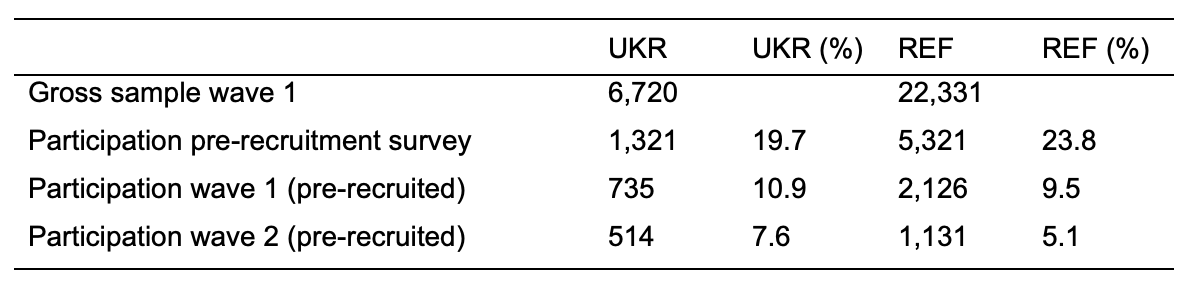
Table 2: Break-down of participation in wave 2 (pre-recruited)
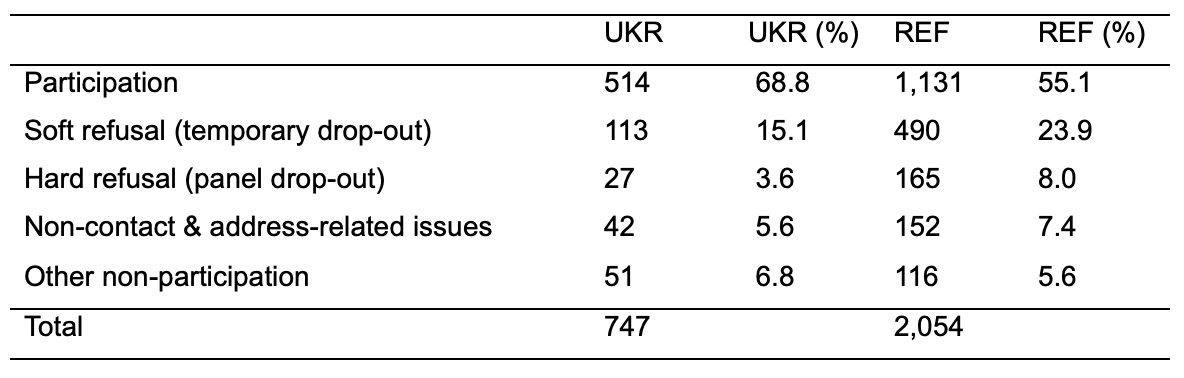
Source: IAB-BAMF-SOEP Survey of Refugees v41 (DOI: 10.5684/soep.core.v41eu).
Note: Percentages are shares of column totals (gross sample wave 2 (pre-recruited)) and do not follow AAPOR response rate definitions. The number reported under “Total” is not identical to the number of households that participated in wave 1 in Table 1, as some households may drop out of the panel between waves due to eligibility criteria, while new split-off households may be added in subsequent waves.
Methods
The main purpose of our analyses is to compare second-wave participation between households of Ukrainian and non-Ukrainian refugees in Germany, and to identify relevant determinants of participation in the second wave, as well as compositional and possibly other unexplained differences between the groups regarding their decision whether to continue participating or not. Therefore, our selection basis is participation in the first wave in 2023 and eligibility to participate in 2024. To ensure comparability, we restrict our analyses to households in the M9 refreshment sample of the IAB-BAMF-SOEP Survey of Refugees that participated in the pre-recruitment survey and whose anchor persons completed the household, the personal, and the biography interview for refugees to have all information needed for the analyses. In total, 675 households of Ukrainian refugees and 1,594 households of refugees from other countries were included in the analyses. These restrictions are driven by data requirements and result in a more engaged analytic sample than the full first-wave sample, which should be kept in mind when interpreting the results.
We go beyond a simple treatment-control comparison, i.e. fitting a single model on the pooled sample with a UKR/REF indicator. Such a specification would implicitly impose common slope coefficients across groups, unless all covariate interactions with group membership are included. In contrast, the decomposition approach estimates separate models for each group, allowing the full vector of coefficients to differ. This enables us to decompose the outcome gap into differences in characteristics (known as the “endowment effect”) and differences in coefficients (known as the “coefficient effect”). The retention probability of household  interviewed by interviewer
  in the first wave is estimated using a linear probability model. All covariates in the model are first-wave information, except for the interviewer continuity. The dependent variable
  equals one if the household has participated in 2024, i.e. at least the household questionnaire was completed, and zero otherwise. The model is specified as
(1) 
where  is the constant,
  is a row vector containing the determinants presented below,
  is a column vector of coefficients,
  is the coefficient for interviewer continuity, and
  is the disturbance term with
 ![\text{E}[\varepsilon_{ij}]=0](https://surveyinsights.org/wp-content/uploads/ql-cache/quicklatex.com-60d8bcc9504fbc4f64c3e9cd2c0dbb68_l3.png "Rendered by QuickLaTeX.com") . The indicator function signals stability in the assignment of the household interviewer between survey waves. Robust standard errors are clustered at the interviewer level, as an interviewer may interview more than one household. The determinants of participation in the second wave were derived from previous research summarised in the second section of this paper. The first (1 UKR) and the second (2 REF) model include characteristics applicable for both samples. The third model (3 REF ext.) includes additional individual characteristics applicable only to the REF sample, as there is no variation in these characteristics for the UKR sample.
. The indicator function signals stability in the assignment of the household interviewer between survey waves. Robust standard errors are clustered at the interviewer level, as an interviewer may interview more than one household. The determinants of participation in the second wave were derived from previous research summarised in the second section of this paper. The first (1 UKR) and the second (2 REF) model include characteristics applicable for both samples. The third model (3 REF ext.) includes additional individual characteristics applicable only to the REF sample, as there is no variation in these characteristics for the UKR sample.
We employ a linear probability model as the decomposition method described below is derived for linear regression models (Blinder, 1973; Kitagawa, 1955; Oaxaca, 1973). Nonlinear decompositions for binary outcomes exist (Fairlie, 2005), but we focus on the linear specification for the ease of interpretation. We use the full model specification for the UKR sample (excluding REF-specific regressors) to conduct a Kitagawa-Blinder-Oaxaca (KBO) decomposition[i],[ii]. Although this method was originally conceptualised to decompose wage differentials across different population groups, it can be applied to other contexts.
Suppose we want to estimate the retention probability for households in the UKR and the REF samples, respectively. Let  and
and  be the column vectors of coefficient estimates fitted by equation (1) (including for simplicity). Further, let
  and
and  be the row vectors of the regressor sample means (including the mean of the indicator variable for change of household interviewer, i.e. the within-group rate of keeping the same interviewer). Let
  and
and  be the estimated constants.
(2) 
By expanding the second line of equation (2), we get the KBO decomposition into the following terms:
The first term (“endowment effect” or effect due to characteristics, reported as “characteristics” in Table 5) describes the part of the differential driven by differences in their compositional characteristics  evaluated at UKR’s levels of returns to these characteristics. A positive (negative) effect means a positive (negative) impact on the difference in average retention between the UKR sample and the REF sample due to the given characteristics of households, which are captured by the regressors.
The second term (“coefficient effect” or effect due to varying effects of these characteristics across groups, reported as “effects of characteristics” in Table 5) describes the part of the differential driven by differences in coefficients  evaluated based on REF’s characteristics. This presents a hypothetical scenario where a UKR household, given REF’s average characteristics, decides whether to continue participation. A positive (negative) effect indicates a corresponding positive (negative) impact on average retention across the two samples.
The third term (“shift coefficient”) represents the unexplained portion of the differential that is not captured by differences in covariates.
It is important to note that in our application the KBO decomposition serves as a descriptive accounting tool. The endowment and coefficient components do not represent causal effects, as the compositional characteristics are not exogenous but reflect migration-related selection processes that may have an impact on participation behaviour. The decomposition therefore quantifies how much of the observed retention gap is statistically associated with compositional differences and should be interpreted descriptively rather than causally. It should be noted, however, that in experimental or quasi-experimental settings where group membership or compositional characteristics can be treated as exogenous, a causal effect can be decomposed.
Results
The following three subsections summarise our results. We first report the sample descriptives, followed by the regression results, and conclude with the decomposition analysis.
Sample descriptives
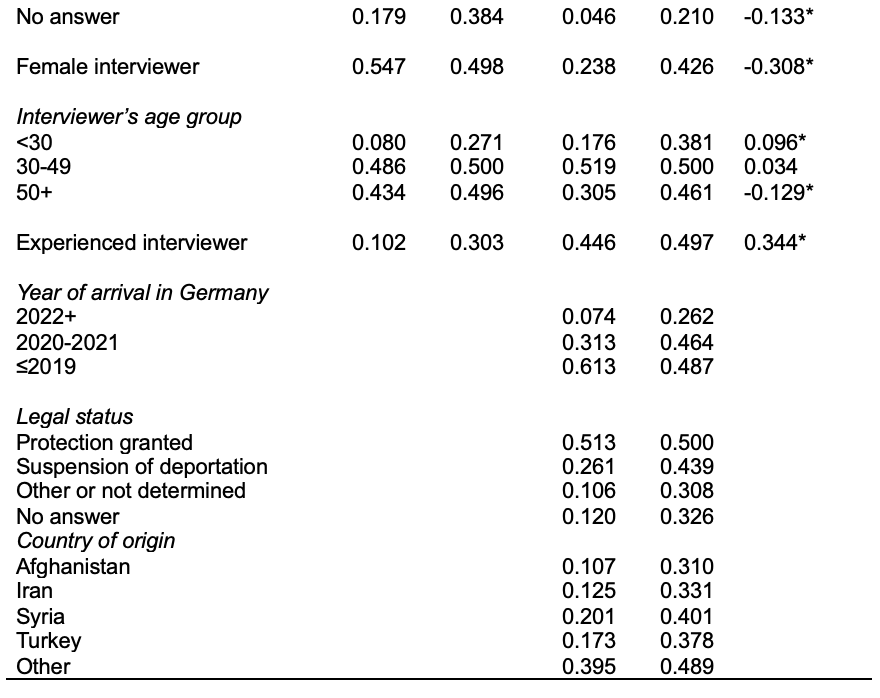
The description in Table 3 indicates that the samples of Ukrainian and non-Ukrainian refugees differ significantly in socio-demographic and interview-related characteristics. Ukrainian refugees are more likely to be female, have a high formal education, and live in private accommodations, but report poorer health status compared to the non-Ukrainian refugees. The median age of Ukrainian refugees is 43, while it is 35 for refugees from other countries. Additionally, Ukrainian refugees have a lower proportion of households in the third income tercile, single-person households, and households with children under 10 years. Approximately 90% of non-Ukrainian refugees express permanent stay intentions in Germany, whereas only 65% of Ukrainian refugees do, with further 18% undecided. The UKR sample includes only households that arrived in Germany since 2022, while the REF sample shows more variation in stay duration, with 61% having arrived in 2019 or earlier. The REF sample includes refugees from various countries, primarily Syria, Turkey, Iran, and Afghanistan.
Major differences also exist in interview-related characteristics. The REF sample has a higher proportion of partially completed households (25% vs. 18% for UKR sample) and a lower proportion of households interviewed by the same interviewer in both waves (interviewer continuity, 21% vs. 34% for UKR sample). There is a higher proportion of language matches between the anchor person’s native language and the interview language in the UKR sample (48% vs. 34% for REF sample). About 55% of interviewers in the UKR sample are female, compared to 24% in the REF sample. Interviewers in the UKR sample are generally older and less experienced, with only 10% having worked in previous waves of the panel, as Ukrainian refugees were included in the IAB-BAMF-SOEP Survey of Refugees for the first time in 2023.
Table 3: Descriptive statistics: sample composition
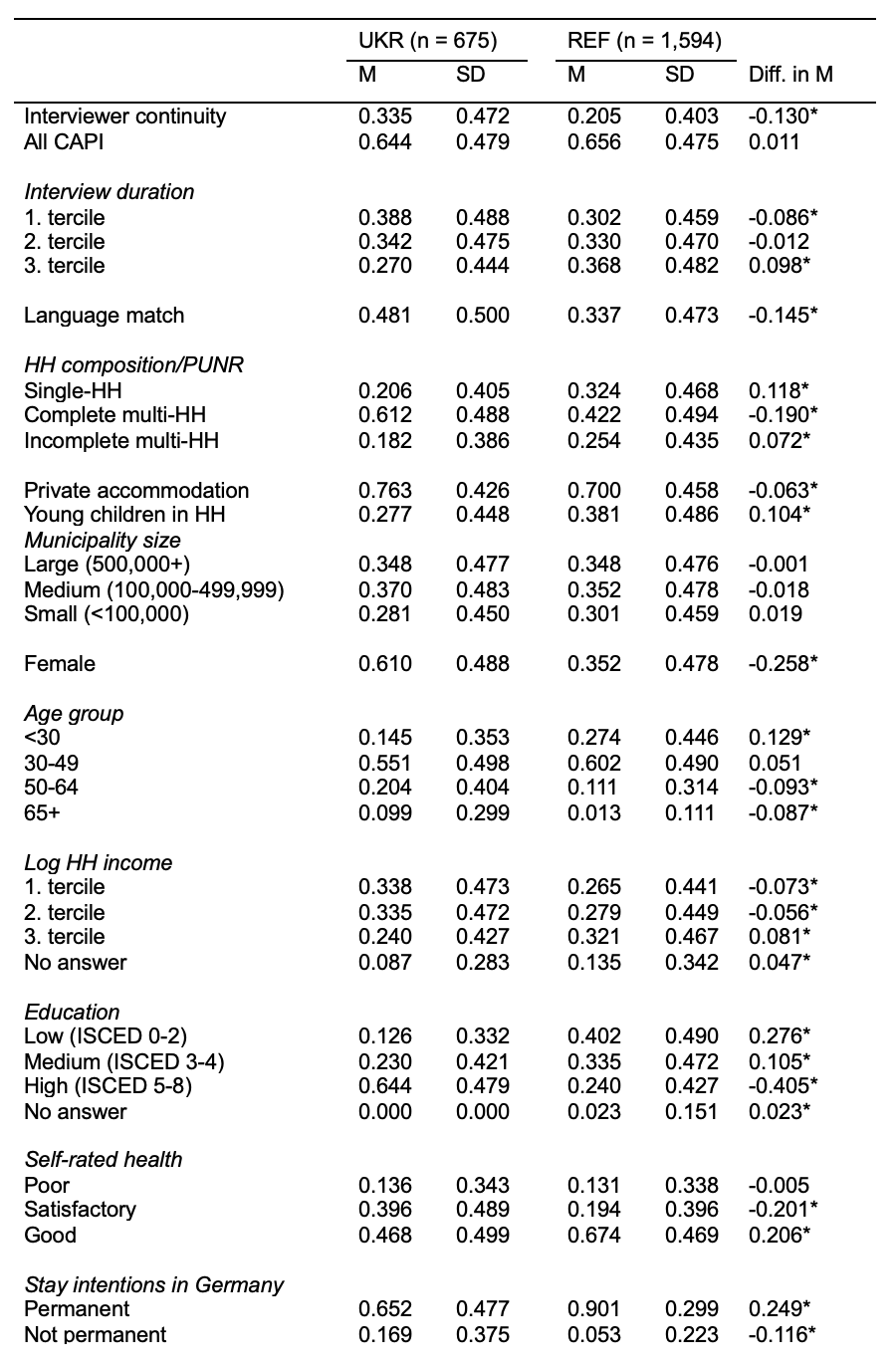
Source: IAB-BAMF-SOEP Survey of Refugees v41 (DOI: 10.5684/soep.core.v41eu).
Note: *p<0.05. Precision of differences in means are obtained by Welch’s t-tests.
Regression results
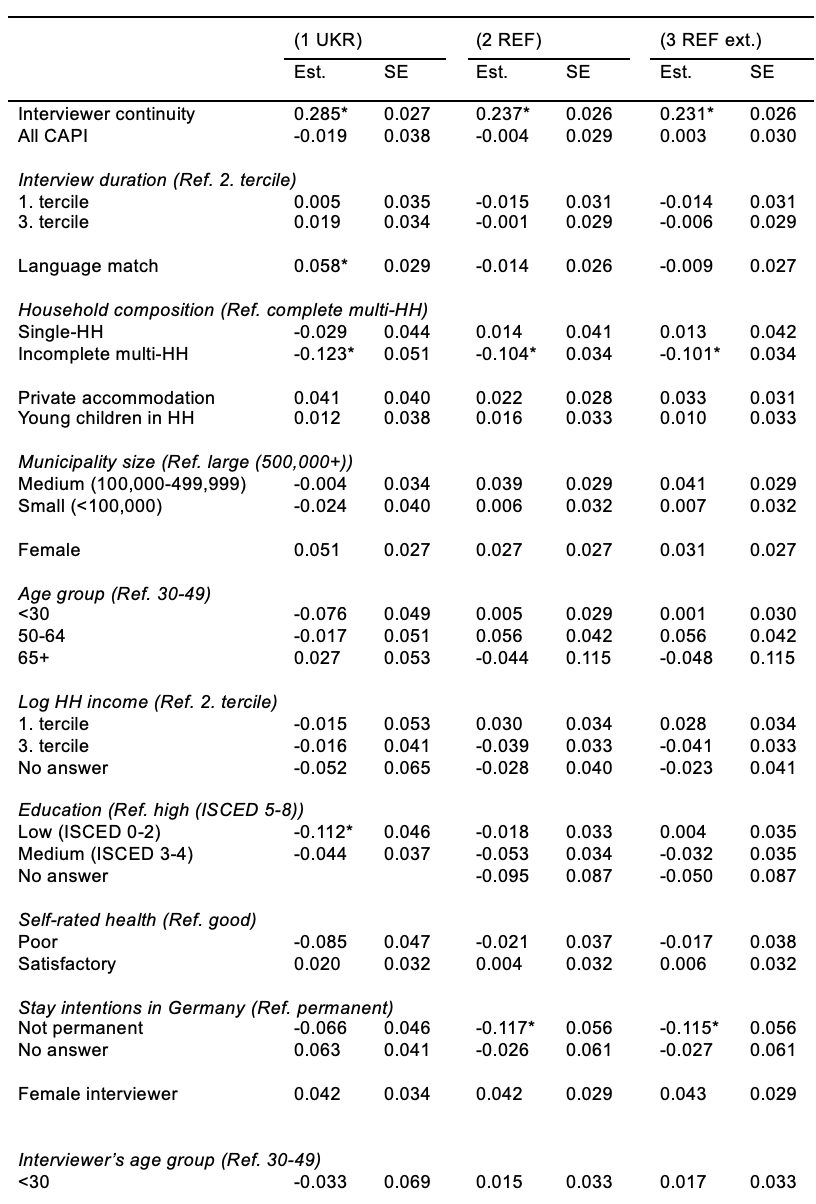
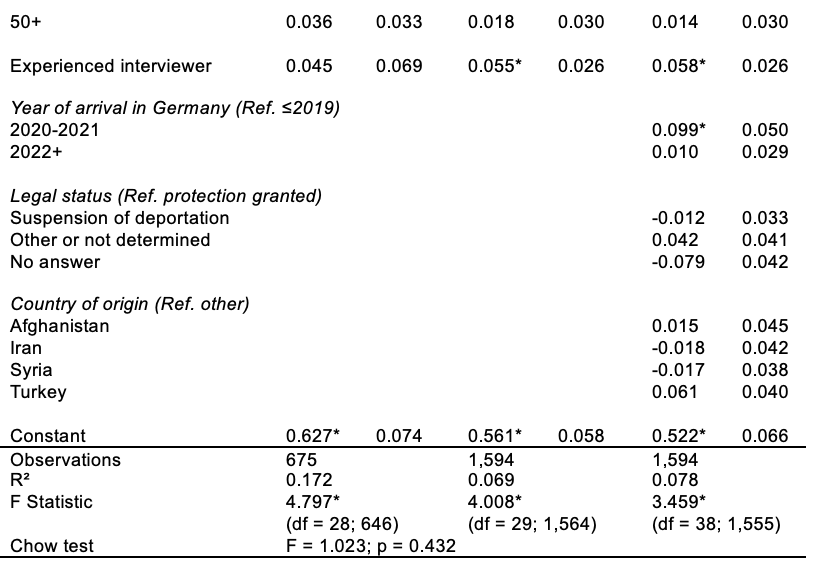
The results of the linear probability models are presented in Table 4 (the significance level is set to 5%). The largest coefficients for both samples are attributed to interviewer continuity between the first and second waves. The coefficients remain stable across models, indicating that the regressor is likely uncorrelated with others.
No detectable effects were found for being a pure face-to-face household or the anchor’s personal interview duration. However, a positive effect exists in the UKR sample for the match of the interview language with the anchor person’s native language. For both samples, PUNR negatively affects participation in the second wave. Factors such as municipality size, household income, presence of children under the age of 10, and type of accommodation do not significantly affect participation.
Table 4: Determinants of household participation in the second wave
Source: IAB-BAMF-SOEP Survey of Refugees v41 (DOI: 10.5684/soep.core.v41eu).
Note: *p<0.05. A Chow test is performed by fitting an LPM on the pooled sample of UKR and REF using the covariates from model (1 UKR), excluding the 37 REF households with missing information on education. A separate model for REF is fitted after excluding these cases.
Regarding individual characteristics of the anchor person, gender, age, and self-reported health status do not correlate with participation in the second wave. In the UKR sample, low education levels are linked to lower participation likelihood, which does not apply to the REF sample. The absence of permanent stay intentions reduces retention probability in the REF sample, but not in the UKR sample. Households whose anchor person arrived in Germany in 2020-2021 are more likely to participate in the second wave than those who arrived in 2019 or earlier. No significant effects of country of origin or legal status on participation were found in the REF sample, providing empirical support for treating non-Ukrainian refugees as a single analytical category: with respect to panel retention, the null results suggest that the shared institutional framework outweighs within-group differences across origin groups.
Interviewer experience positively affects household retention in the REF sample, but this effect is negligible for the UKR sample due to most interviewers being newly recruited. Interviewer gender and age do not significantly influence participation.
The models explain a modest share of the variation in household retention, with R² values of 0.172 for the UKR model, 0.069 for the REF model, and 0.078 for the extended REF model. This is not unusual for models predicting survey participation behaviour, where a large share of variation reflects idiosyncratic household-level factors that are difficult to capture with observable characteristics. The decomposition results presented below should be interpreted in this light.
Decomposition
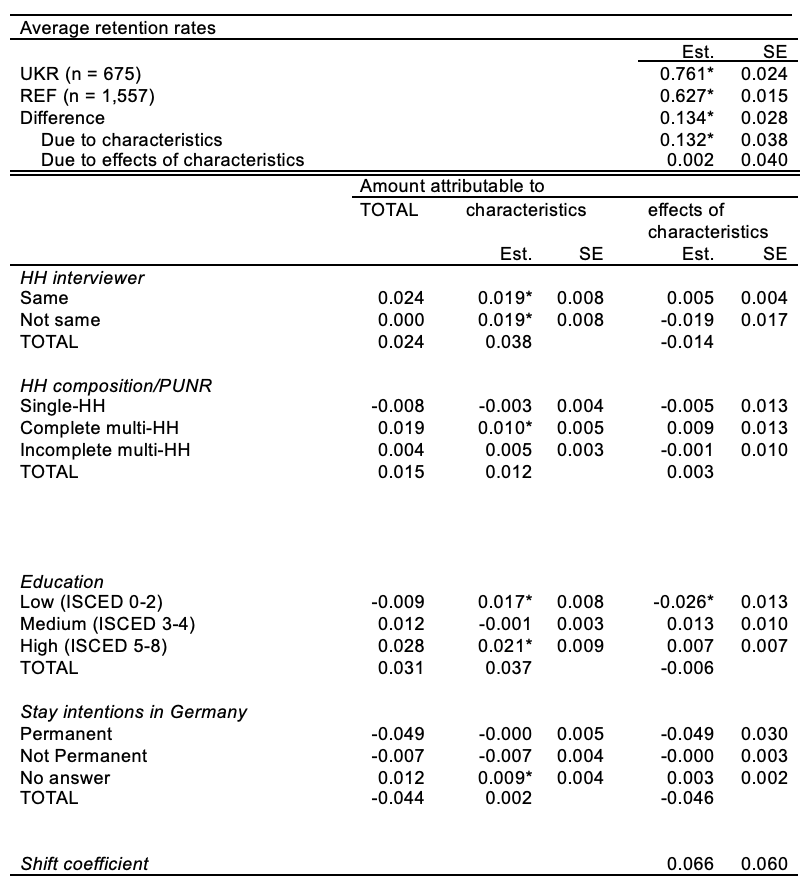
The decomposition results in Table 5 show that the average retention rates for the UKR and REF samples are 76% and 63%, respectively, resulting in a retention differential of 13.4 percentage points. This difference is almost entirely attributed to variations in characteristics (endowment effect, 13.2 percentage points), with almost no difference in how these characteristics influence retention decisions (coefficient effect, 0.2 percentage points). Although the decomposition is performed using the model specification shown in the first two columns of Table 4, Table 5 only reports the covariates that significantly contribute to the retention differential.
Table 5: Decomposition of the retention differential
Source: IAB-BAMF-SOEP Survey of Refugees v41 (DOI: 10.5684/soep.core.v41eu).
Note: *p<0.05. 37 REF households with unknown employment status of the anchor person are dropped from the sample. The overall retention rates are estimated as group means. The values in the “Amount attributable to / TOTAL” column are the sum of the “characteristics” and “effects of characteristics” components shown in the two columns to the right. Consequently, they are not independent point estimates and do not have their own standard errors. The same reasoning applies to the “TOTAL” rows.
About four percentage points of the retention differential arise from 34% of households in the UKR sample retaining the same interviewer between waves, compared to 21% in the REF sample. This difference is not due to one group valuing interviewer continuity more than the other. Similarly, the lower proportion of PUNR in the UKR sample contributes one percentage point to the retention differential. However, the difference in how the two samples deal with the PUNR shows no significant impact on retention.
About an additional four percentage points of the retention differential arise from differences in education between the two samples. When examining anchor persons with low formal education, a more complex picture emerges. Although the endowment effect for low formal education is positive, its coefficient effect is negative. This indicates that, despite a higher proportion of anchor persons with a low education degree in the REF sample contributing to the retention differential, the households with low educated anchor persons in the UKR sample face a greater risk of dropping out than their REF counterparts. In the UKR sample, anchor persons with low education have a more detrimental impact on retention. However, this effect cancels out in the total contribution to the retention differential.
Lastly, uncertainty about stay intentions in Germany is more pronounced in the UKR sample, which reduces the retention differential. This effect is driven by differences in characteristics rather than by differences due to the effect of this characteristic, as the intention to leave Germany does not significantly affect retention probability for the UKR sample compared to the REF sample.
As the shift coefficient is not statistically significantly different from zero, there is no tangible residual effect of possible unexplained variation.
Discussion and conclusion
The first goal of this paper is to provide field-based insights into panel retention between the first and second waves of data collection in a probability-based household panel of refugees in Germany, approached from a comparative perspective. To achieve this goal, we compared the participation of Ukrainian refugees and refugees from other countries within the same survey over two waves and analysed the determinants of panel retention in these groups.
In contrast to our first hypothesis (H1), our analyses indicate that, except for education in the Ukrainian sample, socio-demographic characteristics (e.g. age, gender, income) are not the primary factors influencing continued participation. Instead, other individual factors, such as long-term stay intentions in the host country, along with interview-related characteristics, were found to be more relevant. Although the survey adhered to the same fieldwork procedures, interviewer training, and questionnaires, the interview-related characteristics did vary between the two groups. In a self-completion setting, these differences may diminish, resulting in a smaller panel retention gap.
Our second hypothesis (H2) is confirmed for the REF sample. An absence of permanent stay intentions in Germany is negatively associated with participation in the second wave. In line with the leverage-salience theory of survey participation (Groves et al., 2000), the perceived reward of participation might be greater for households intending to stay in Germany, as the study’s outcomes hold more significance for them. To improve coverage of households with temporary stay intentions, advance letters should emphasise the importance of continued participation regardless of stay intentions. Related to this, it should be noted that the situation of Ukrainian refugees differs from that of other refugees, as they receive more generous protection status as compared to refugees from other countries (Mickelsson, 2025). In line with the social exchange theory of survey participation (Dillman et al., 2014), the higher participation rates in both waves among Ukrainian refugees may reflect acts of reciprocity and gratitude. However, given the current developments and changing policies regarding Ukrainian and other refugees in Germany, further research is needed to analyse how these changes might affect panel retention in the future.
Our third hypothesis (H3) posited that a higher respondent burden, measured by language mismatch and lengthy interview, would decrease participation in the second wave. This hypothesis is partly confirmed for the Ukrainian sample, where alignment between the anchor person’s native language and the interview language positively affects participation. In contrast, this effect is absent in the REF sample, likely due to limited language options to cover a wide range of languages and the fact that participants have generally spent more time in Germany, allowing them to learn German. Offering survey materials and conducting interviews in various languages is crucial for recently arrived refugees and migrants. Although this approach incurs additional costs, promising advancements in automated translation (e.g. Zavala-Rojas et al., 2024) may provide cost-effective alternatives, especially for self-completion modes.
Our fourth hypothesis (H4) is confirmed for both samples. Consistent with previous research, interviewer continuity positively affects participation in the second wave. Interviewers with prior experience in the survey were associated with higher participation rates in the REF sample. In our analysis, interviewer continuity exhibits the strongest effect on panel retention across both samples. It should be noted, however, that interviewer continuity is not randomly distributed and may be correlated with unobserved household characteristics that independently influence retention. Consequently, the estimated effect of interviewer continuity may partly reflect household-level selection rather than a genuine interviewer effect and should therefore be interpreted with caution. Retaining the same interviewers across waves is advisable, though it is not always feasible. Given the recent challenge of interviewer shortages and the shift to online data collection, the impact of this transition on retention in previously face-to-face panels remains uncertain. For instance, an analysis of a CAWI follow-up for soft refusals and non-contacts in the IAB-BAMF-SOEP Survey of Refugees (Büchner et al., 2025) demonstrates that offering an online mode of data collection was especially effective among households that experienced an interviewer change between two waves. Regarding PUNR, both samples indicate that incomplete households, where not all eligible members participated in the first wave, are more likely to drop out in the second wave, confirming our fifth hypothesis (H5). Our findings suggest that PUNR negatively impacts household participation, highlighting the need for strategies to minimise it, such as personalised outreach to eligible members and additional incentives for complete data. Future research should address and explore the mechanisms underlying PUNR in household surveys and its impact on panel retention.
The second goal of our paper is to extend the standard regression analysis of panel retention predictors by integrating a decomposition method to enable a more nuanced analysis of the retention gap. Our analyses began by observing differing panel retention rates in the Ukrainian and non-Ukrainian samples of refugees. We anticipated that the differences in panel retention primarily result from variations in sample composition. Applying the KBO decomposition allowed us to disentangle the sources of group differences in panel retention and to distinguish between differences attributable to differences in observable sample composition characteristics, differential effects of these characteristics, and unobserved factors on panel retention. The results of the decomposition support our main hypothesis (H6), confirming that the differences in retention arise almost entirely from variations in sample characteristics rather than from differing effects of these characteristics or other unexplained factors. Consistent with H6, the higher rate of interviewer continuity and the lower proportion of incomplete multi-person households in the UKR sample emerged as the primary contributors to the endowment component. Tertiary education also contributed positively to the endowment component as expected, though the decomposition revealed an additional complexity: low-educated anchor persons in the UKR sample face a substantially higher dropout risk than their REF counterparts, a pattern that partially offsets the compositional advantage. In this sense, the method provided important analytical clarity: it confirmed that the retention gap largely reflects structural differences in sample composition, which is consistent with the substantial heterogeneity between the two groups.
Against the criterion we set out, namely whether the KBO decomposition adds analytical clarity beyond a group-indicator regression, the results are positive: the method quantified the characteristics and effects of characteristics split, confirmed the primary source of the retention gap, and surfaced the education asymmetry that would have remained invisible in a pooled model. That said, the analytical value of the KBO decomposition for the analysis of survey participation and panel retention may be particularly pronounced in settings where groups are more similar in their observable characteristics but still exhibit participation differences. In such cases, the decomposition could provide deeper insights into sources of panel retention going beyond compositional differences. In our case, the strong compositional divergence between samples limits the scope for identifying such differences; nevertheless, the method strengthens the robustness and interpretability of our findings by confirming the primary source of the gap observed.
Endnotes
[i] The method is limited to linear, non-hierarchical models. We conducted a sensitivity analysis by estimating multilevel models with interviewer-level random intercepts, which indicated only minor interviewer effects in the REF sample, negligible relative to residual variation, supporting the adequacy of a single-level specification.
[ii] We use the user-written Stata implementation of the KBO decomposition written by Jann (2008) that provides the normalisation method outlined by Yun (2005). Approximate variance estimators for the decomposition are provided using the delta method (see Jann (2008) for the derivation).
* Correction (17 August 2026): In the original equation (1), a “+” was inadvertently omitted before the disturbance term. This has been corrected in the current version of the article.
References
- Becker, R. (2022). Gender and Survey Participation: An Event History Analysis of the Gender Effects of Survey Participation in a Probability-based Multi-wave Panel Study with a Sequential Mixed-mode Design. methods, data, analyses, 16(1), 3–32. https://doi.org/10.12758/mda.2021.08
- Behr, A., Bellgardt, E. & Rendtel, U. (2005). Extent and Determinants of Panel Attrition in the European Community Household Panel. European Sociological Review, 21(5), 489–512. https://doi.org/10.1093/esr/jci037
- Blinder, A. S. (1973). Wage Discrimination: Reduced Form and Structural Estimates. The Journal of Human Resources, 8(4), 436–455. https://doi.org/10.2307/144855
- Blohm, M. & Diehl, C. (2001). Wenn Migranten Migranten befragen: Zum Teilnahmeverhalten von Einwanderern bei Bevölkerungsbefragungen. Zeitschrift für Soziologie, 30(3), 223–242. https://doi.org/10.1515/zfsoz-2001-0304
- Brücker, H., Kosyakova, Y., Rother, N., Zinn, S., Liebau, E., Gider, W., Schwanhäuser, S. & Siegert, M. (2025). Exploring Integration and Migration Dynamics: The Research Potentials of a Large-Scale Longitudinal Household Study of Refugees in Germany. European Sociological Review. https://doi.org/10.1093/esr/jcaf032
- Büchner, T., Ruland, M., Sommer, E., Süttmann, F., & Zinn, S. (2025) Lohnt sich ein CAWI-Follow-Up für Face-to-Face? Erste Ergebnisse aus der IAB-BAMF-SOEP-Befragung von Geflüchteten. Lagemaß, 15, 43-44.
- Cabrera-Álvarez, P., James, N. & Lynn, P. (2023). Panel Attrition in the General Population Sample and the Immigrant and Ethnic Minority Boost of Understanding Society. Understanding Society Working Papers Series, No. 2023-03. https://api.semanticscholar.org/CorpusID:259338455
- Décieux, J. P., Zinn, S., & Ette, A. (2025). Effects of changing the incentive strategy on panel performance: Experimental evidence from a probability-based online panel of refugees. Survey Research Methods, 19(2), 223–239. https://doi.org/10.18148/srm/2025.v19i2.8437
- Dillman, D. A., Smyth, J. D. & Christian, L. M. (2014). Internet, Phone, Mail, and Mixed-Mode Surveys: The Tailored Design Method. John Wiley & Sons. https://doi.org/10.1002/9781394260645
- Duvoisin, A., Refle, J.-E., Burton-Jeangros, C., Consoli, L., Fakhoury, J. & Jackson, Y. (2024). Recruitment and Attrition for Panel Surveys of Hard-to-reach Populations: Some Lessons from a Longitudinal Study on Undocumented Migrants. Field Methods, 36(4), 294–310. https://doi.org/10.1177/1525822X231210415
- Fairlie, R. W. (2005). An extension of the Blinder-Oaxaca decomposition technique to logit and probit models, Journal of Economic and Social Measurement, 30(4),305–316. https://doi.org/10.3233/JEM-2005-0259
- Feskens, R., Hox, J., Lensvelt-Mulders, G. & Schmeets, H. (2007). Nonresponse Among Ethnic Minorities: A Multivariate Analysis. Journal of Official Statistics, 23(3), 387–408.
- Groves, R. M., Cialdini, R. B., & Couper, M. P. (1992). Understanding The Decision to Participate in a Survey. The Public Opinion Quarterly, 56(4), 475–495. http://www.jstor.org/stable/2749203
- Groves, R. M., Fowler, F. J., Couper, M. P., Lepkowski, J. M., Singer, E., & Tourangeau, R. (2009). Survey Methodology (2nd ed.) John Wiley & Sons.
- Groves, R. M., Singer, E. Corning, A. (2000). Leverage-Saliency Theory of Survey Participation: Description and an Illustration. Public Opinion Quarterly, 64(3), 299–308. http://www.jstor.org/stable/3078721
- IAB-BAMF-SOEP Survey of Refugees (2026). IAB-BAMF-SOEP Survey of Refugees, data 2016-2024.https:/doi.org/10.5684/soep.iab-bamf-soep-mig.2024
- Jäckle, A., Lynn, P., Sinibaldi, J. & Tipping, S. (2012). The Effect of Interviewer Experience, Attitudes, Personality and Skills on Respondent Co-operation with Face-to-Face Surveys. Survey Research Methods, 7(1), 1–15. https://doi.org/10.18148/srm/2013.v7i1.4736
- Jacobsen, J. and Kühne, S. (2021). Using a Mobile App When Surveying Highly Mobile Populations: Panel Attrition, Consent, and Interviewer Effects in a Survey of Refugees. Social Science Computer Review, 39(4):721–743. https://doi.org/10.1177/0894439320985250
- Jacobsen, J. & Siegert, M. (2023). Establishing a Panel Study of Refugees in Germany: First Wave Response and Panel Attrition from a Comparative Perspective. Field Methods, 36(3), 229–248. https://doi.org/10.1177/1525822X231204817
- Jann, B. (2008). The Blinder–Oaxaca decomposition for linear regression models. The Stata Journal, 8(4), 453–479. https://doi.org/10.1177/1536867×0800800401
- Kappelhof, J. (2014). The effect of different survey designs on nonresponse in surveys among non-Western minorities in The Netherlands. Survey Research Methods, 8(2), 81–98. https://doi.org/10.18148/srm/2014.v8i2.5784
- Kitagawa, E. M. (1955). Components of a Difference Between Two Rates. Journal of the American Statistical Association, 50(272), 1168–1194.
- Kosyakova, Y. (2024). Schutzsuchende aus der Ukraine unterscheiden sich in Alter und Geschlecht von jenen aus anderen Ländern. IAB-Forum – Grafik aktuell No. 22.10.2024. https://doi.org/10.48720/IAB.FOO.GA.20241022.01
- Kühne, S. (2018). From Strangers to Acquaintances? Interviewer Continuity and Socially Desirable Responses in Panel Surveys. Survey Research Methods, 12(2), 121–146. https://doi.org/10.18148/srm/2018.v12i2.7299
- Kühne, S., Jacobsen, J. & Kroh, M. (2019). Sampling in Times of High Immigration: The Survey Process of the IAB-BAMF-SOEP Survey of Refugees. Survey Methods: Insights from the Field. https://doi.org/10.13094/SMIF-2019-00005
- Lipps, O. (2009). Attrition of Households and Individuals in Panel Surveys. SOEPpapers on Multidisciplinary Panel Data Research 164. Berlin: DIW/SOEP https://ideas.repec.org/p/diw/diwsop/diw_sp164.html
- Lipps, O. (2010). Interviewer-Respondent Socio-Demographic Matching and Survey Cooperation. Survey Practice, 3(4). https://doi.org/10.29115/SP-2010-0019
- Lipps, O., Laganà, F., Pollien, A. & Gianettoni, L. (2013). Under- representation of foreign minorities in cross-sectional and longitudinal surveys in Switzerland. In Surveying Ethnic Minorities and Immigrant Populations, edited by Font, J. and Méndez, M., 241–270. Amsterdam University Press. https://doi.org/10.1017/9789048519187.012
- Lynn, P. & Borkowska, M. (2018). Some Indicators of Sample Representativeness and Attrition Bias for BHPS and Understanding Society. Understanding Society Working Paper Series, No. 2018-01. https://api.semanticscholar.org/CorpusID:134751780
- Lynn, P., Kaminska, O. & Goldstein, H. (2014). Panel Attrition: How Important is Interviewer Continuity? Journal of Official Statistics, 30(3):443–457. https://doi.org/10.2478/jos-2014-0028
- Massey, D. S. & Tourangeau, R. (2012). New Challenges to Social Measurement Introduction. Annals of the American Academy of Political and Social Science, 645(1):6–22. https://doi.org/10.1177/0002716212463314
- Méndez, M. & Font, J. (2013). Surveying immigrant populations: Methodological strategies, good practices and open questions. In Surveying Ethnic Minorities and Immigrant Populations, edited by Font, J. and Méndez, M., 241–270. Amsterdam University Press. https://doi.org/10.1017/9789048519187.013
- Mickelsson, T.B. (2025). Ukrainian Refugees’ Differentiated Treatment: A Critical and Systematic Review. Global Networks, 25. https://doi.org/10.1111/glob.12502
- Morales, L. & Ros, V. (2013). Comparing the Response Rates of Autochthonous and Migrant Populations in Nominal Sampling Surveys: The LOCALMULTIDEM study in Madrid. In Surveying Ethnic Minorities and Immigrant Populations, edited by Font, J. and Méndez, M., 147–172. Amsterdam University Press. https://doi.org/10.1515/9789048519187-008
- Oaxaca, R. L. (1973). Male-Female Wage Differentials in Urban Labor Markets. International Economics Review, 14(3), 693–709. https://doi.org/10.2307/2525981
- Rothenbühler, M. & Voorpostel, M. (2016). Attrition in the Swiss Household Panel: Are vulnerable groups more affected than others? In Surveying Human Vulnerabilities across the Life Course, edited by Oris, M., Roberts, C., Joye, D., and Stähli, M. E., 223–244. Springer. https://doi.org/10.1007/978-3-319-24157-9_10
- Siegers, R., Steinhauer, H. W. & Schütt, J. (2022). SOEP-Core v37 – Documentation of sample sizes and panel attrition in the German Socio-Economic Panel (SOEP) (1984 until 2020). SOEP Survey Papers 1106, Series C – Data Documentations. Berlin: DIW/SOEP. https://hdl.handle.net/10419/259554
- Steinhauer, H. W., Siegert, M., Süttmann, F., Siegers, R. & Zinn, S. (2025). IAB-BAMF-SOEP Survey of Refugees – 2023: Sampling, Nonresponse, and Weighting of the Sample M9. SOEP Survey Papers 1537, Series C – Data Documentations. Berlin: DIW/SOEP. https://hdl.handle.net/10419/331794
- Vandecasteele, L. & Debels, A. (2007). Attrition in Panel Data: The Effectiveness of Weighting. European Sociological Review, 23(1), 81–97. https://doi.org/10.1093/esr/jcl021
- Wenzel, L., Husen, O. & Sandermann, P. (2022). Surveying Diverse Subpopulations in Refugee Studies: Reflections on Sampling, Implementation, and Translation Strategies Drawn from Experiences with a Regional Quantitative Survey on Refugee Parents in Germany. Journal of Refugee Studies, 35(4), 1593–1615. https://doi.org/10.1093/jrs/feac043
- West, B. T., Elliott, M. R., Mneimneh, Z., Wagner, J., Peytchev, A. & Trappmann, M. (2020). An Examination of an Interviewer-Respondent Matching Protocol in a Longitudinal CATI Study. Journal of Survey Statistics and Methodology, 8(2), 304–324. https://doi.org/10.1093/jssam/smy028
- Yun, M.-S. (2005). A simple solution to the identification in detailed wage decompositions. Economic Inquiry, 43(4), 766–772. https://doi.org/10.1093/ei/cbi053
- Zavala-Rojas, D., Behr, D., Dorer, B., Sorato, D., & Keck, V. (2024). Using Machine Translation and Post-Editing in the TRAPD Approach: Effects on the Quality of Translated Survey Texts. Public Opinion Quarterly, 88(1), 123–148. https://doi.org/10.1093/poq/nfad060
-
Keywords
calibration CATI coverage coverage bias cross-national surveys data linkage data quality European Social Survey experiment face-to-face face-to-face survey Facebook hard to reach populations incentives item nonresponse measurement measurement error mixed-mode surveys multitasking non-probability samples Nonresponse nonresponse bias nonresponse rates paradata PIAAC Probability sample probability samples QR codes rare populations response rate Satisficing social desirability Social media survey survey-taking climate survey data survey management survey methods Telephone survey telephone surveys total survey error unit nonresponse validity web survey Web surveys weighting